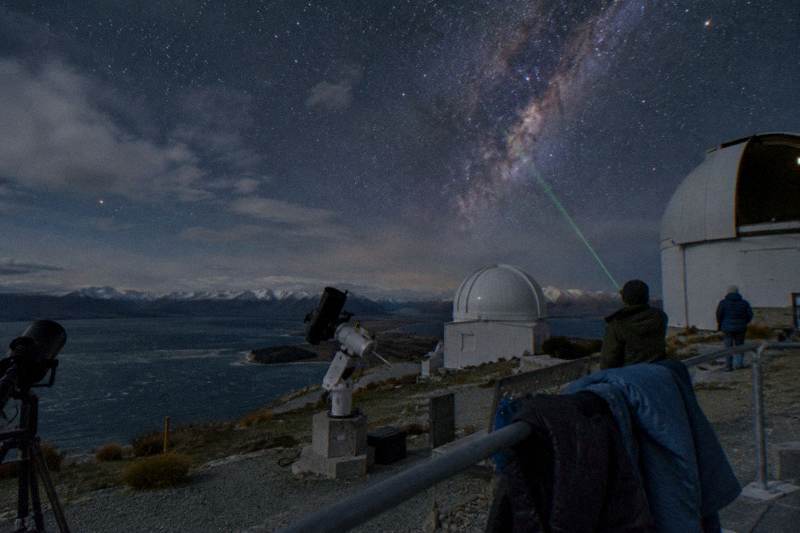
What Happens When Cloud Cancels A Tekapo Stargazing Tour?
Cloud is the single biggest variable in any Tekapo stargazing booking, and the two main operators treat it very differently: Dark Sky Project decides close to tour time and offers an indoor alternative, a reschedule, a voucher or a full refund, while Tekapo Springs runs in all weather with a virtual reality substitute and a partial refund rule.
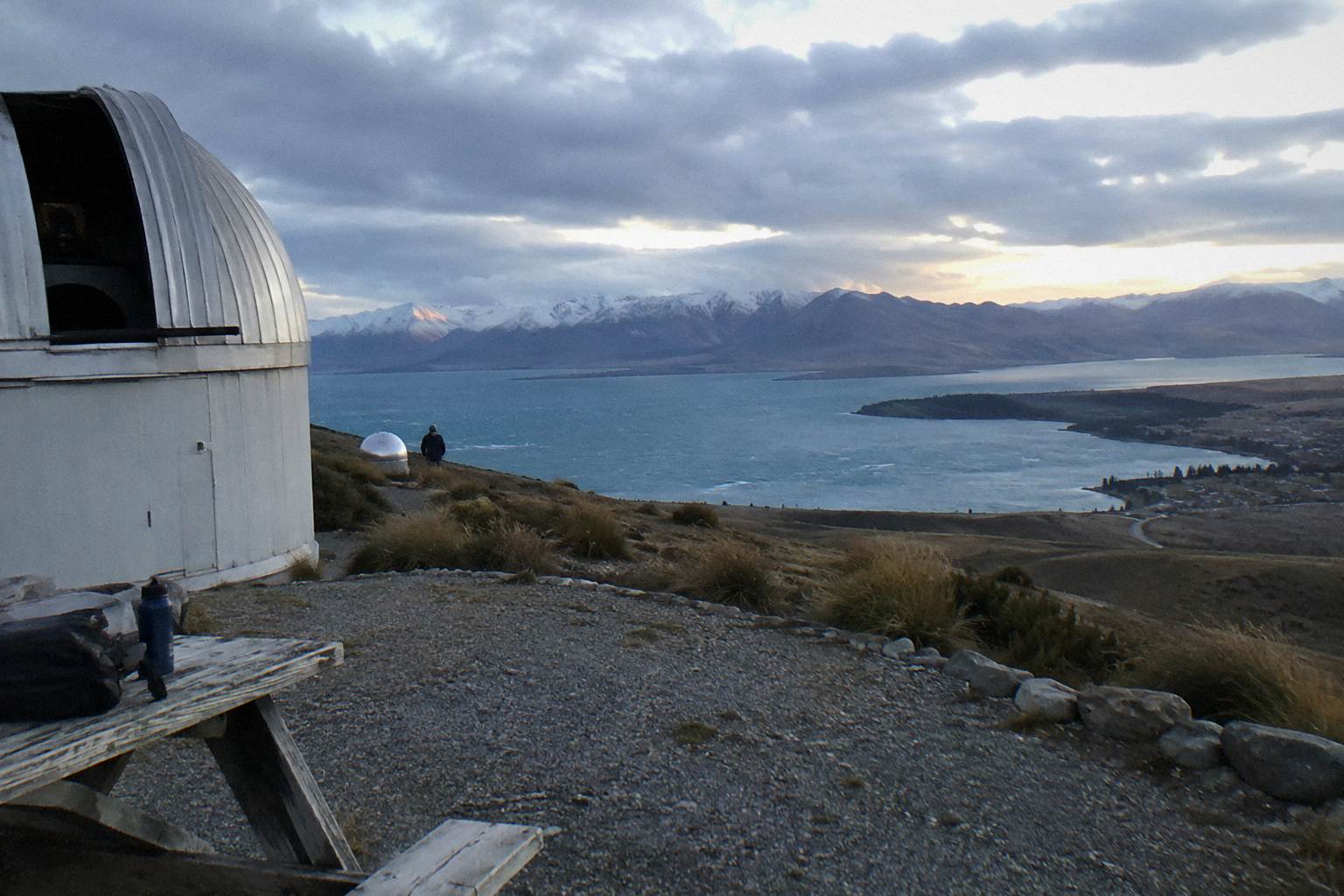
Short answer
If cloud cancels a Dark Sky Project tour, the operator offers an indoor alternative or the Virtual Stargazing Experience, a reschedule, a gift voucher valid 3 years, or a full refund, with the decision made as close to tour time as possible. Tekapo Springs tours run in all weather, with a VR experience replacing telescope viewing and a 25 percent refund per ticket if viewing is under 30 minutes.
This guide sits alongside the site's coverage of how to read a Tekapo stargazing forecast; start there for the sky itself, and here for what happens to your money and your evening when the sky refuses to cooperate.
| Question | The short answer |
|---|---|
| Does Dark Sky Project cancel for cloud? | It can; the decision is made as close to tour time as possible |
| What do you get if it cancels? | Indoor alternative or Virtual Stargazing Experience, reschedule, gift voucher valid 3 years, or full refund |
| Does Tekapo Springs cancel for weather? | No; tours run in all weather, with a VR experience under cloud |
| Partial refund at Tekapo Springs? | 25 percent per ticket if telescope viewing is under 30 minutes |
| Which tour ignores weather entirely? | The indoor Dark Sky Experience, a 45 minute daytime session |
| Can you cancel yourself? | Both operators allow changes up to 24 hours before, direct bookings |
When cloud cancels a Dark Sky Project tour, the operator offers an indoor alternative or the Virtual Stargazing Experience, a reschedule subject to availability, a gift voucher valid 3 years, or a full refund, with the decision made close to tour time. Tekapo Springs tours run in all weather, swapping telescope viewing for a virtual reality experience under cloud, with a 25 percent refund if viewing drops under 30 minutes.
That is the whole picture in one paragraph, but the detail matters because the two policies are built on opposite philosophies. Dark Sky Project treats the live sky as the product: when cloud rules the outdoor session out, the outdoor session does not run, and the operator's weather page spells out the fallback ladder. Tekapo Springs treats the evening as the product: the tour departs regardless, and cloud changes what happens inside it rather than whether it happens at all.
Neither operator promises objects, clarity or conditions, and both say so in their own terms. Dark Sky Project's pages state that it cannot guarantee clarity, the Milky Way or Aurora Australis, and that brighter moonlight affects fainter stars and galaxies. Tekapo Springs advertises stargazing confidently, but its own terms say clarity cannot be guaranteed. Any sentence anywhere that promises you a specific sight under a specific sky is a sentence to stop trusting.
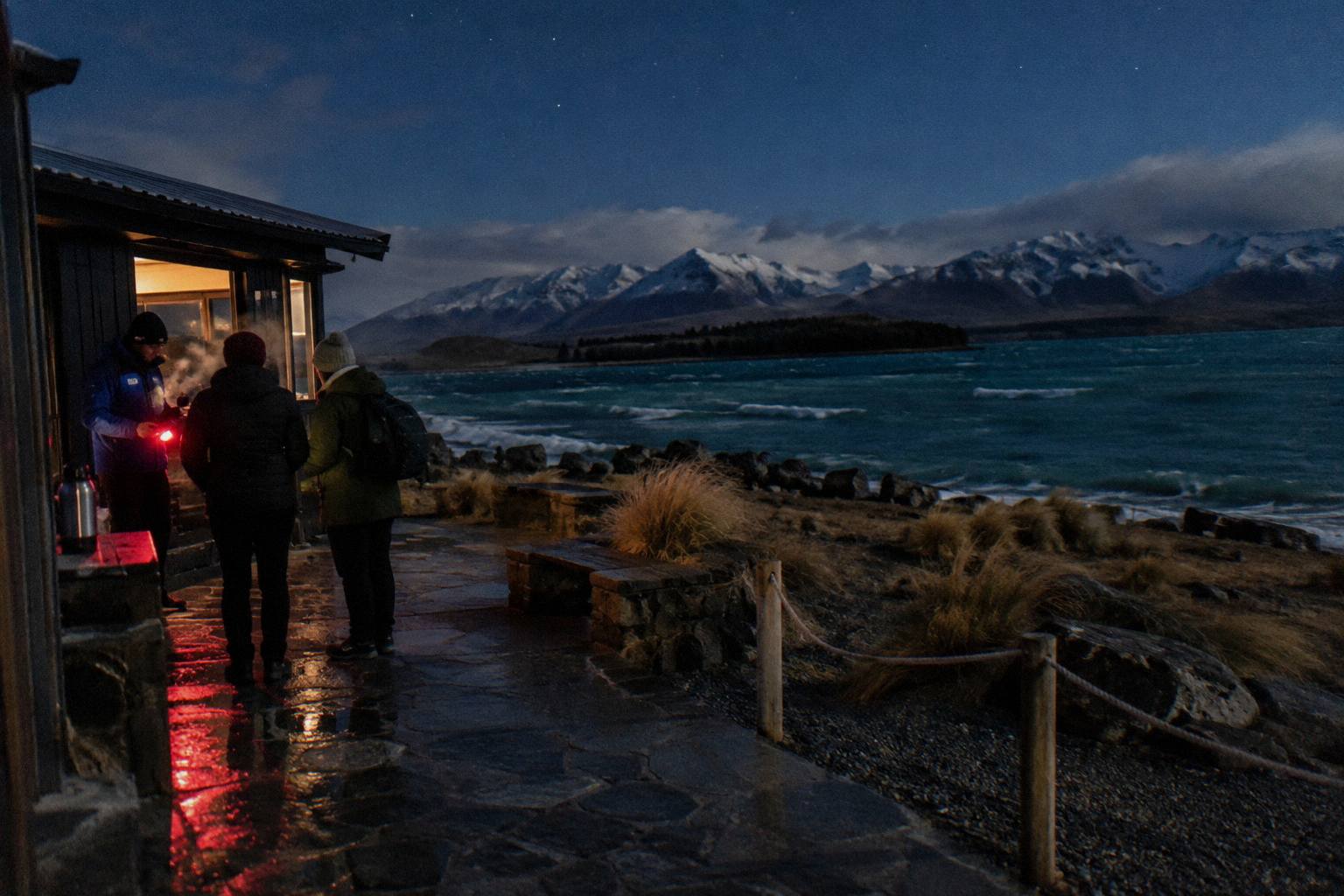
The practical consequence for a visitor is that booking a Tekapo stargazing tour is not a bet you can lose outright. At worst you spend the evening on an indoor astronomy experience, or you take a voucher and come back another night, or you take the refund and spend the money on dinner. The risk is not financial; it is the risk that the night you planned around the sky becomes a night doing something else.
How Dark Sky Project Handles Cloud: The Fallback Ladder
Dark Sky Project cannot guarantee clarity or any object, and the go or no-go decision is made as close to tour time as possible, with the update given at check-in 15 minutes early. If outdoor stargazing is not possible, the ladder is an indoor alternative or the Virtual Stargazing Experience, a reschedule subject to availability, a gift voucher valid 3 years, or a full refund.
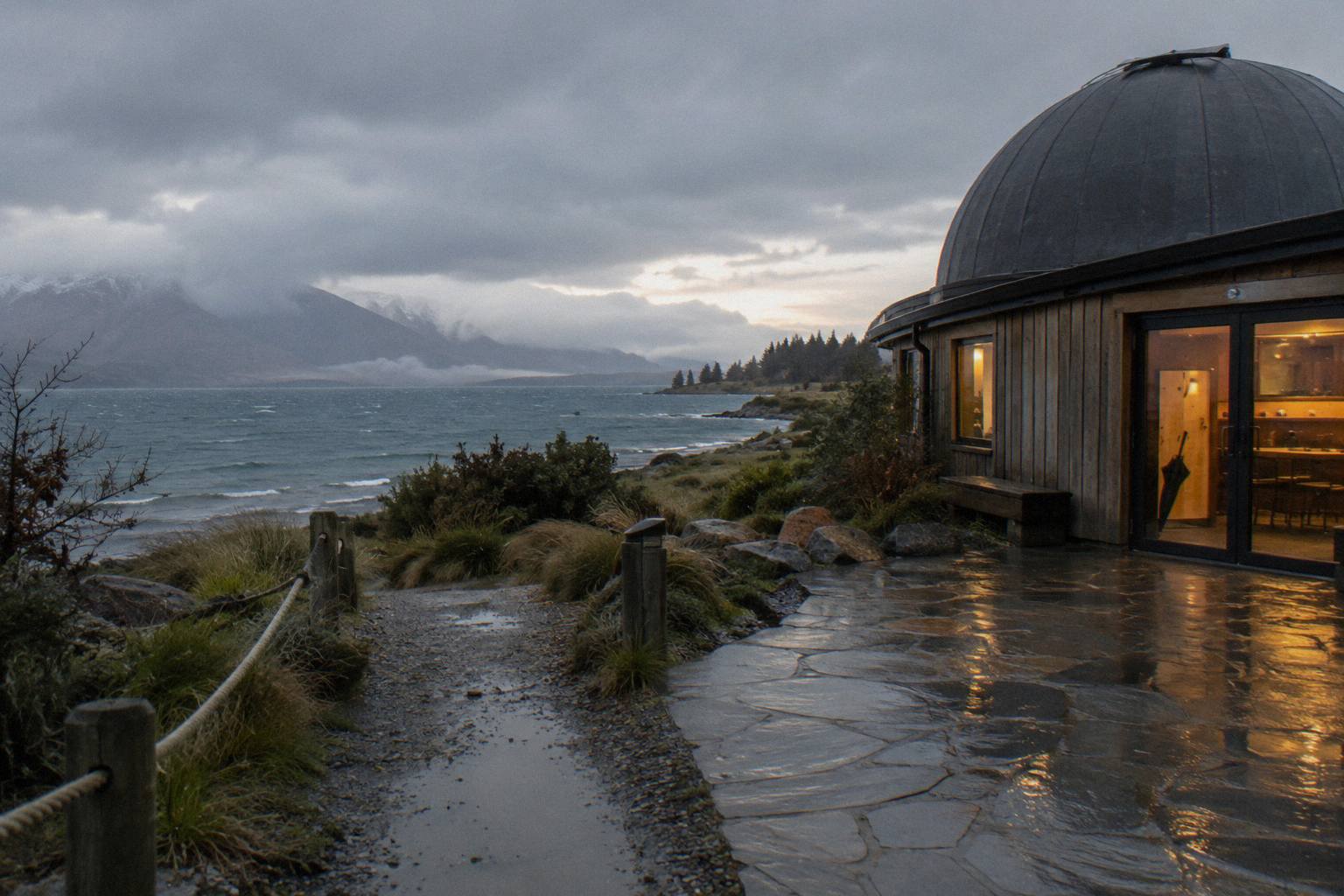
The sequence matters. The operator does not cancel a Summit or Crater session the morning of; it waits, because Tekapo cloud is patchy and a forecast of cloud at 6pm can be a clear gap at 11pm. That is why check-in is 15 minutes before departure at the base on Motuariki Lane, and why the update comes at check-in rather than by email hours earlier. If you are booked on the Mt John Summit Stargazing Experience, the 4.6 across 352 reviews reflects nights that ran, not a promise that yours will.
The fallback ladder, in the operator's own order, is an indoor alternative or the Virtual Stargazing Experience first. The Virtual Stargazing Experience is an indoor, weather-independent session at the base, and it exists precisely for nights when the outdoor product cannot run. A reschedule comes next, subject to availability, which is worth thinking about if you are in Tekapo for one night only: the next available slot may not be yours to take. The gift voucher is valid 3 years, which suits travellers who know they will return to the Mackenzie Basin. The full refund is the final option and it is a genuine full refund, not a credit.
Your own cancellation rights are separate from weather cancellation. The operator's terms and conditions allow direct bookings to be cancelled up to 24 hours before for a full refund; inside 24 hours the full price is charged. Groups of 10 or more face tighter windows: no refunds inside 72 hours for the Summit and Crater experiences, and 48 hours for the indoor Dark Sky Experience. Late check-in earns no refund at all, weather or no weather, so the 15 minute early rule is not decorative.
One more nuance from the operator's own weather page: the moon is not treated purely as the enemy. Brighter moonlight affects fainter stars and galaxies, but Dark Sky Project also says the moon is a good target in its own right, and telescopes still show bright objects under moonlight. A moonlit night is not a cancelled night; it is a different night.
| Dark Sky Project fallback | What it means for you |
|---|---|
| Indoor alternative or Virtual Stargazing Experience | The evening still happens, indoors at the base |
| Reschedule | Subject to availability; risky on a one-night stay |
| Gift voucher | Valid 3 years; suits a return trip |
| Full refund | Available if the alternatives do not fit |
| Your own cancellation | Direct bookings, full refund up to 24 hours before |
Does Tekapo Springs Run Stargazing Tours In Rain And Cloud?
Yes. Tekapo Springs states that its stargazing tours run in all weather, and when cloud blocks the sky a virtual reality indoor experience with 360 degree imagery replaces the telescope viewing. If telescope viewing falls under 30 minutes, the operator refunds 25 percent per ticket, a policy it applies to tours from 18 June 2026. Changes and cancellations by you are allowed up to 24 hours before for a full refund, date change or voucher.
The all-weather model changes how you should read a Tekapo Springs booking. Soak in the Stars, the operator's 90 minute hot pools and stargazing combination, is built around an exclusive hot pool at 37.5 to 38.5 degrees Celsius with a guide poolside, towels, robes, hot drinks and warm poncho coats. The pool half of that evening is weather-proof by design. The telescope half is the exposed part, and under cloud it is replaced by the VR experience, whose 360 degree imagery includes the Church of the Good Shepherd and the Mt John summit. The VR session is a substitute inside the tour, not a standalone product.
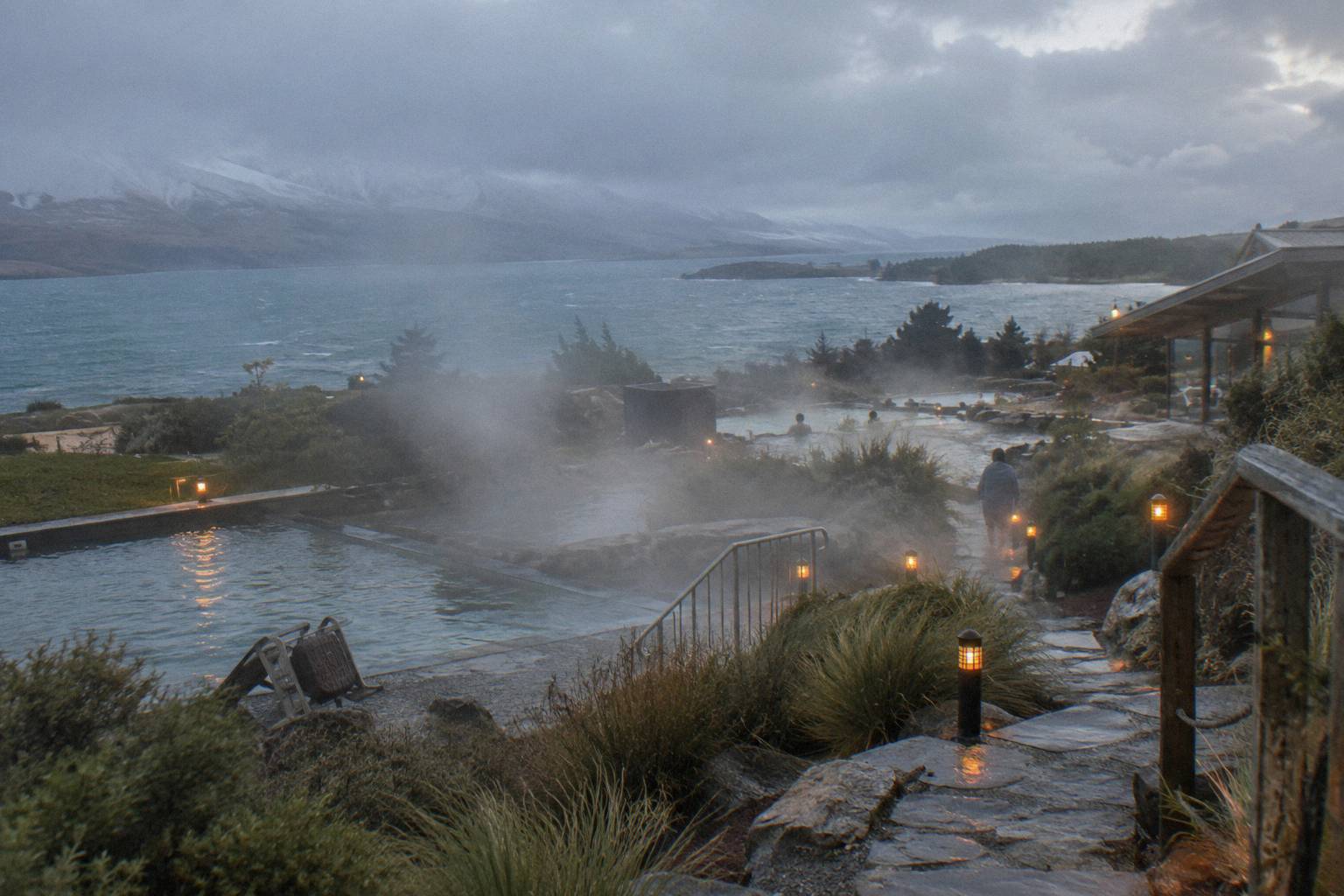
The partial refund rule is the honest edge of the policy. If you get under 30 minutes of telescope viewing, 25 percent comes back per ticket at the end of the tour, for tours from 18 June 2026, and the operator excludes Economy, Premium and Premium Plus tickets from that rule. It is not a full refund for a clouded night, and it is not meant to be: the operator's position is that the soak, the gear and the guiding all still happened.
Scheduling is the other cloud-adjacent wrinkle. Soak in the Stars runs 7 evenings a week from October to April and Thursday to Monday from May to September, with some tours beginning after midnight, and the operator's own example is a 12:15am start. Late starts exist because the operator schedules around darkness, not despite it. Times are seasonal and set by calendar, so check the specific evening when you book. The operator's own pages at Tekapo Springs stargazing carry the current schedule.
Pricing, for completeness, is the operator's own: Soak in the Stars is NZD 179 adult, NZD 159 senior or student, NZD 115 child and NZD 499 family, on the operator's current schedule. There is no printable rating for this tour, so judge it on its policy fit for you rather than on a score.
A family detail worth flagging: Tekapo Springs allows no child under 6 on any of its tours, including babies carried, and Soak in the Stars has a minimum age of 10. If cloud planning and child planning collide, the age limits matter more than the weather policy.
The One Tour Cloud Cannot Touch: The Indoor Dark Sky Experience
The Dark Sky Experience, Indoor Cultural Astronomy is a 45 minute indoor, daytime guided tour at the Dark Sky Project base, so weather does not change it at all. The operator's price is NZD 59 adult and NZD 39 child, with a family pass at NZD 157 and under 5s free with an adult ticket. English sessions run at 10:30am, 12:30pm and 2:30pm, with a 4:30pm session on Tuesday and Wednesday, subject to availability.
This is the product to hold in your back pocket. It is not a stargazing tour and does not pretend to be: there is no telescope viewing and no sky. What it offers is a four zone guided astronomy tour inside the base building, weaving together Māori astronomy, which the operator calls tatai aroraki, with the restored 125 year old Brashear telescope as the centrepiece. Because it runs in daylight and indoors, it is the natural plan B when the evening product collapses, and the natural plan A for travellers whose schedule leaves them in Tekapo during the day only.
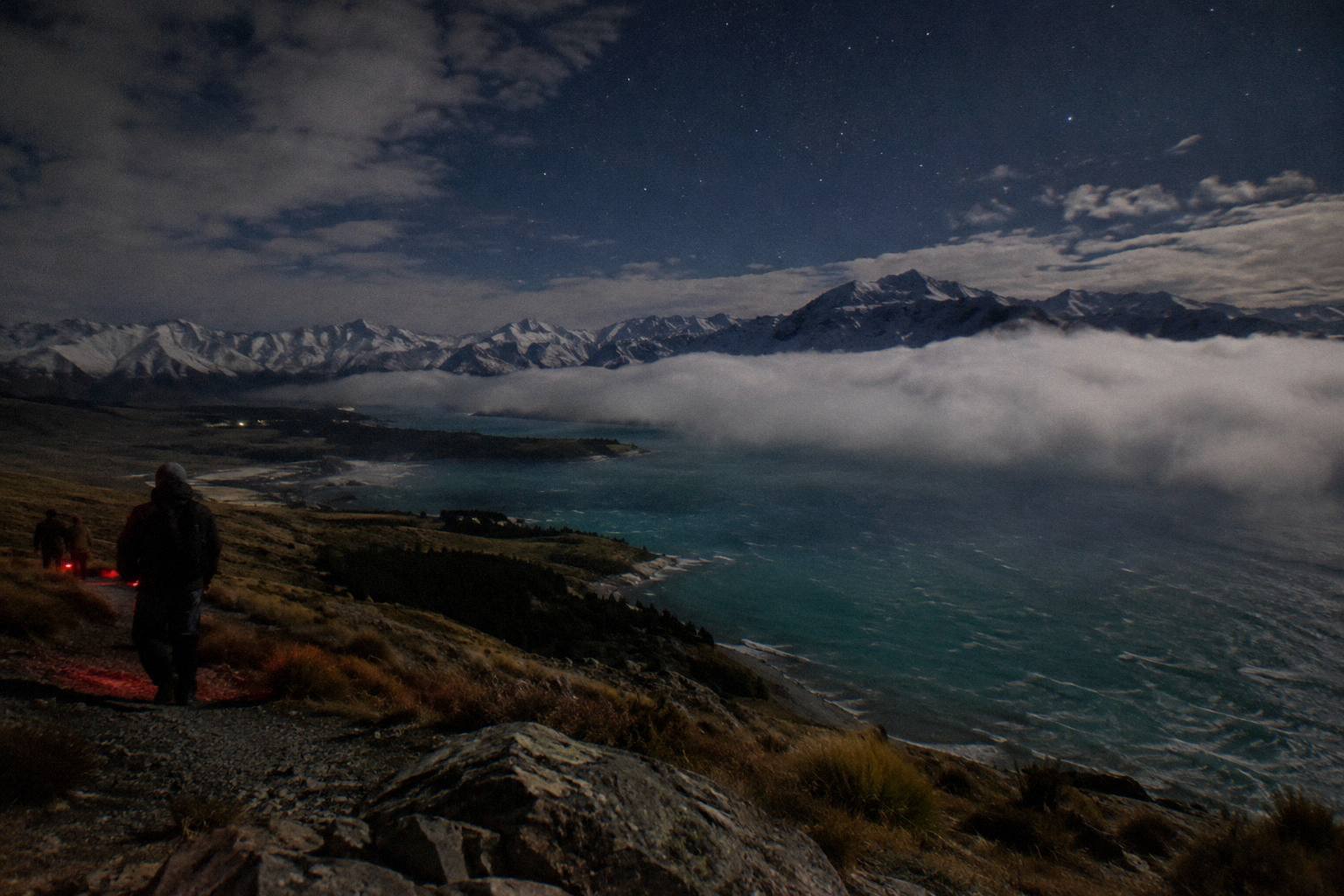
It also happens to be the cheapest way into the subject on offer here. At NZD 59 adult it costs less than a quarter of the Summit Experience's NZD 239, and the operator says its content suits ages from about 7, with no minimum age and under 5s free with an adult ticket. The full tour page carries the details, and the tour holds a rating of 4.6 across 54 reviews.
The strategic play is worth spelling out. Book your night tour for the clearest-looking evening of your stay, and if cloud takes it, the Dark Sky Experience is a same-day substitute that needs no sky at all: sessions are frequent, the venue is the same base building you would have checked into anyway, and the operator's fallback ladder explicitly offers it as the indoor alternative. Travellers who plan both rarely leave Tekapo with nothing.
The other indoor option in the same family is the Virtual Stargazing Experience, which Dark Sky Project lists among its offers as the indoor weather alternative. Where the Dark Sky Experience is cultural astronomy by day, the Virtual Stargazing Experience is the operator's dedicated cloud substitute for the night products. Think of the one as a plan and the other as a parachute.
Cloud, Moon And Season: Reading The Tekapo Sky Before You Book
Cloud is the cancellation trigger, but the moon changes what a clear night delivers: Dark Sky Project says brighter moonlight affects fainter stars and galaxies, while telescopes still show bright objects and the moon itself is a good target. The Aoraki Mackenzie International Dark Sky Reserve, awarded in April 2012, protects darkness at the landscape scale, but no designation controls the weather. Milky Way and aurora depend on conditions and are not guaranteed by any operator.
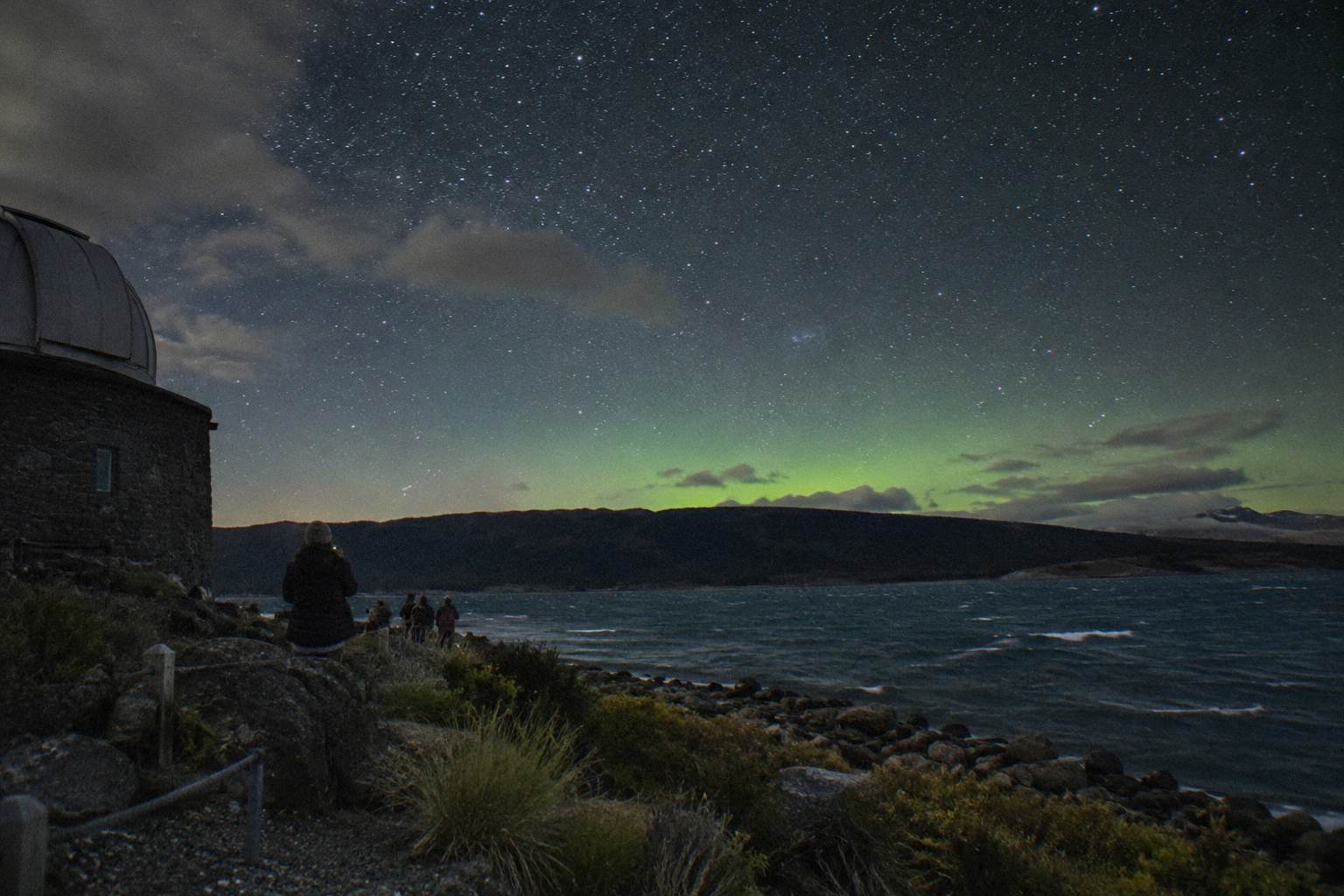
The moon question deserves its own honesty. A full moon night is not a broken booking; it is a night with a different menu. Both major operators say versions of the same thing: the moon washes out the fainter naked eye material, and the Milky Way in particular suffers, but the telescope work continues on bright targets. If your dream is the naked eye Milky Way arch, the moon phase matters more than a small amount of cloud; the site's guide to new moon or full moon stargazing at Tekapo works through that trade in detail.
The reserve context explains why people book here at all. The Aoraki Mackenzie International Dark Sky Reserve, awarded reserve status in April 2012, comprises Aoraki/Mt Cook National Park and the Mackenzie Basin and is the largest dark sky reserve in the Southern Hemisphere. The Mackenzie District has rules on outdoor lighting in its District Plan, which is part of why the darkness holds. None of that moves a frontal cloud band, and that is the gap between a protected sky and a usable one.
Season shapes the odds too, though no operator publishes a cloud statistic, and none is invented here. What is stated: Soak in the Stars runs 7 evenings a week October to April and 5 evenings a week in the colder months, and Summit times shift with sunset across the year. For planning the timing question in full, the site's piece on the best time to go stargazing at Lake Tekapo is the companion read.
| Sky condition | Dark Sky Project (Summit, Crater) | Tekapo Springs |
|---|---|---|
| Clear night | Tour runs | Tour runs |
| Thick cloud | Possible cancellation, decision close to tour time | Tour runs, VR replaces viewing |
| Under 30 minutes viewing | Not stated as a refund trigger | 25 percent refund per ticket |
| Bright moon | Tour runs; fainter objects affected | Tour runs; bright objects still shown |
| Rain | Possible cancellation | Tour runs |
Refunds, Reschedules And Vouchers: The Two Operators Compared
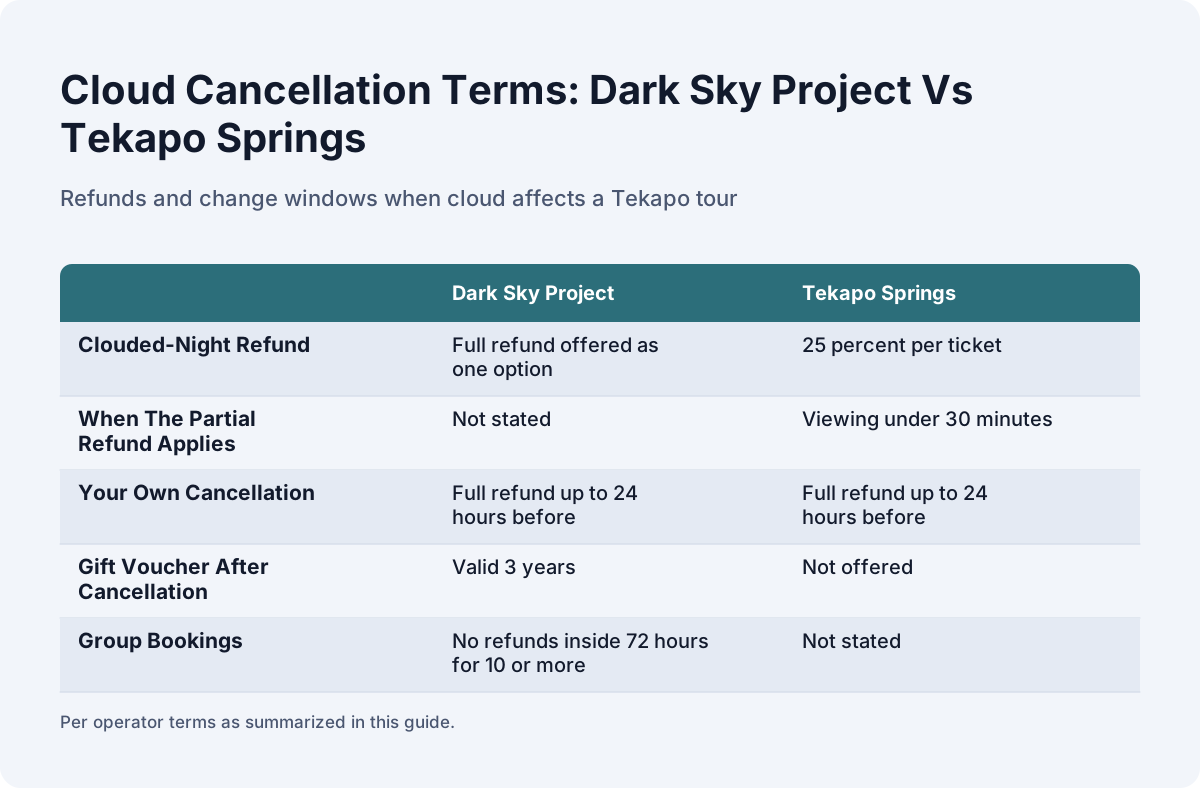
Dark Sky Project and Tekapo Springs both allow you to cancel or change up to 24 hours before on direct bookings, but they diverge after that: Dark Sky Project cancels the tour itself when cloud rules out the sky and then offers alternatives or a full refund, while Tekapo Springs does not cancel, substitutes VR, and caps the weather remedy at a 25 percent refund. Group bookings and third party bookings follow different terms at both.
The cleanest way to see the difference is side by side.
| Item | Dark Sky Project | Tekapo Springs |
|---|---|---|
| Weather cancellation by operator | Possible, decided close to tour time | Does not cancel for weather |
| Cloud substitute | Indoor alternative or Virtual Stargazing Experience | VR indoor experience, 360 degree imagery |
| Weather refund | Full refund if you decline the alternatives | 25 percent per ticket if viewing under 30 minutes |
| Reschedule | Offered, subject to availability | Date change offered |
| Voucher | Valid 3 years | Voucher offered on cancellation |
| Your cancellation window | 24 hours, direct bookings | 24 hours, direct bookings |
| Group rule | 10 or more: no refunds inside 72 h (Summit, Crater), 48 h (Dark Sky Experience) | Not stated; ask the operator |
Read the two refund columns carefully, because they answer different questions. Dark Sky Project's full refund answers "what if the product I paid for cannot be delivered". Tekapo Springs' 25 percent answer responds to "what if part of the evening was clouded out". Both are honest positions; they are just not the same position, and knowing which one you are buying is the whole point of comparing them before you pay.
Third party bookings are a footnote that matters: Dark Sky Project's terms say third party bookings follow the agent's terms, and Tekapo Springs says the same about bookings made via agents. The 24 hour windows described here are the operators' direct booking terms, and the booking page you use may carry its own cancellation window. Check the page you actually pay on, not the operator's site, for that term.
If a gap in the table is not stated anywhere, the honest move is to ask before paying: Dark Sky Project on +64 3 680 6960 or info@darkskyproject.co.nz, and Tekapo Springs on +64 3 680 6550 or bookings@tekapostargazing.co.nz.
Booking Strategy: Should You Wait For The Forecast Or Book Ahead?
Book ahead, and stack the deck: choose the clearest looking night of your stay, keep the cancellation windows intact by booking direct, and hold the indoor Dark Sky Experience as the weather-proof plan B. Waiting for the forecast often means the popular sessions are full, and the 24 hour cancellation windows mean an early booking costs you nothing until the day itself.
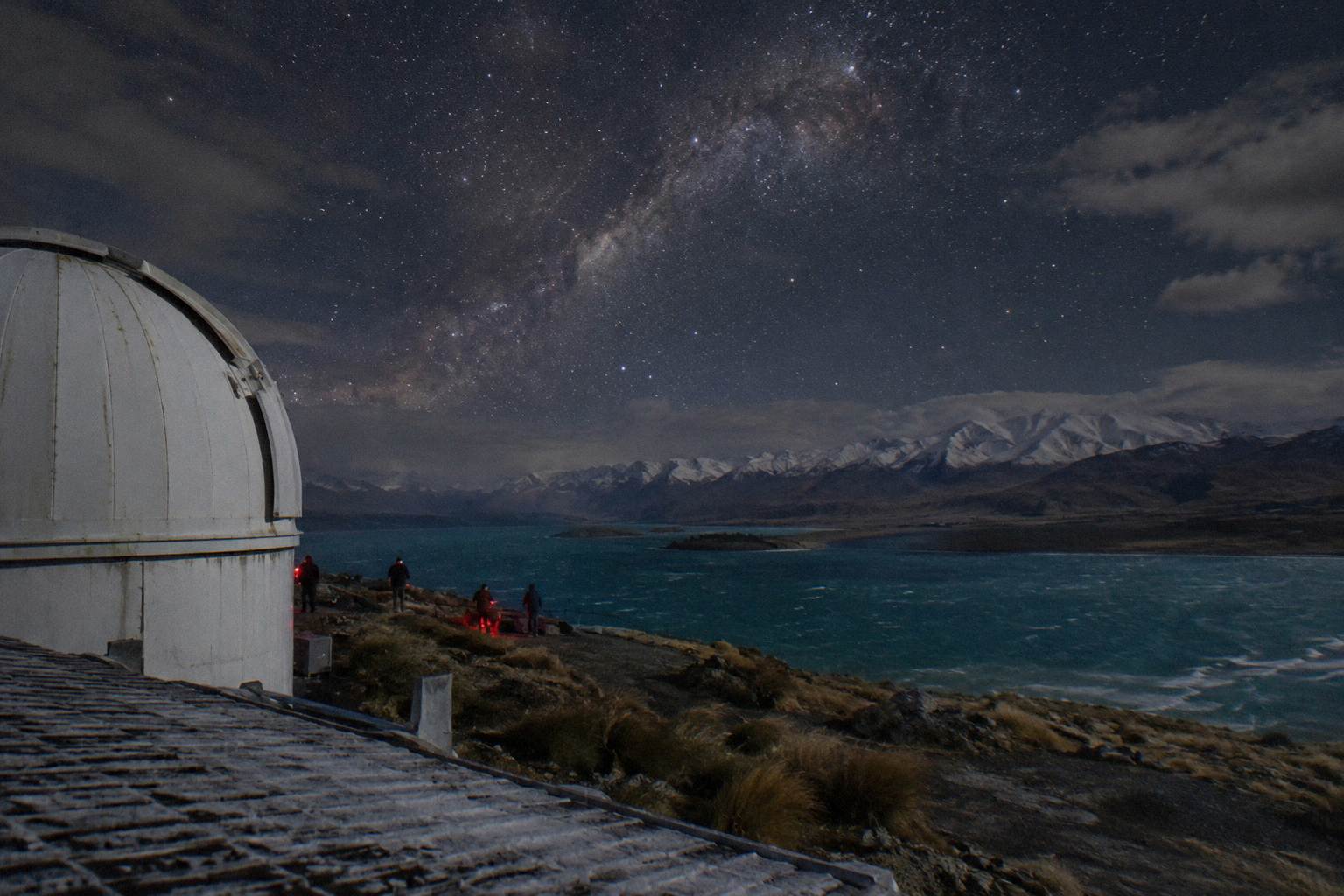
The core trade is forecast certainty against availability. Tekapo's night products fill, and the Summit Experience, 1 hour 45 minutes at the University of Canterbury Mt John Observatory with telescopes up to 16 inch inside a private dome, is the one people plan trips around. Its operator price is NZD 239 for adult and child alike, minimum age 10, and it includes the bus up, an Extreme Cold Weather jacket loan and a 100 m gravel incline walk in the dark, so it needs moderate fitness as well as a gap in the cloud. If you wait until the forecast looks good, the session you want may be gone.
The counter-strategy works because of the cancellation windows. Since both operators let direct bookings change or cancel up to 24 hours before, an early booking is a free option on a clear night. You are not gambling money; you are gambling calendar. Book the Summit for your best-guess night, book the Crater Experience, the cheaper Dark Sky Project outdoor product at NZD 139 adult and NZD 99 child with a family pass at NZD 377, as an overlapping option if your stay is short, and let the 24 hour windows do the pruning. You can compare the two in the site's guide to Dark Sky Project's stargazing tours.
For a one-night stay the calculus flips toward Tekapo Springs, because a tour that runs in all weather cannot be lost to cloud at all. For a two or three night stay, Dark Sky Project's ladder of alternatives plus a reschedule is powerful: if night one clouds over, a reschedule to night two, subject to availability, may save the trip. Travellers wrestling with exactly this should also read how many nights you need in Tekapo for stargazing.
A worked example makes the logic concrete. A couple arrives Thursday, leaves Sunday, and wants the summit. They book the Summit Experience for Friday, the statistically middle night, at check-in-friendly timing. Thursday evening they read the sky and the forecast on the site's Tekapo stargazing forecast guide. If Friday looks clouded, they cancel by the 24 hour mark, rebook Saturday, and add the Saturday 2:30pm Dark Sky Experience as a daytime floor under the whole plan. If Saturday also fails at check-in, the operator's ladder offers the indoor alternative, a voucher for a future trip, or the refund. The worst case is a 45 minute indoor astronomy session and money back.
What Trips People Up When Cloud Threatens A Stargazing Booking
The recurring mistakes are assuming the tour will be cancelled early in the day when the decision actually comes close to tour time, expecting a refund for a tour that ran with a VR substitute, and missing the 15 minute early check-in that costs the whole ticket if late. Group bookings face tighter refund windows than the standard 24 hours, and third party bookings follow the agent's terms, not the operator's.
First trap: waiting for a morning cancellation email that never comes. Dark Sky Project decides as close to tour time as possible because Tekapo cloud is changeable, and the update lands at check-in, 15 minutes before departure. Plan your evening around the tour running until told otherwise.
Second trap: expecting the Tekapo Springs model to behave like the Dark Sky Project model. If you book Soak in the Stars and the sky is thick cloud, the tour runs, the VR experience replaces the viewing, and the remedy is capped at the 25 percent refund under the 30 minute threshold. Booking it while hoping for a full-refund escape hatch is a mismatch between expectation and policy.
Third trap: the clock. Late check-in at Dark Sky Project earns no refund, full stop. The base is 1 Motuariki Lane, Takapō (Tekapo), on the lakefront, and finding parking in a busy village evening takes longer than you think. Fourth trap: group terms. Ten or more people, no refunds inside 72 hours for Summit or Crater. Fifth trap: booking through an agent and reading the operator's cancellation page, because the agent's terms govern. Sixth, and gentlest: writing off a moon-heavy night. Both operators say bright objects hold up and the moon is a target worth pointing a telescope at.
Common Questions About Cloud And Tekapo Stargazing Weather
What Happens When Cloud Cancels A Tekapo Stargazing Tour?
Dark Sky Project decides close to tour time whether the outdoor session can run. If it cannot, the operator offers an indoor alternative or the Virtual Stargazing Experience, a reschedule subject to availability, a gift voucher valid 3 years, or a full refund. Tekapo Springs tours run in all weather, with a VR experience replacing telescope viewing and a 25 percent refund per ticket if viewing is under 30 minutes.
Do Tekapo Stargazing Tours Get Cancelled For Cloud?
Dark Sky Project tours can be, with the decision made as close to tour time as possible and the update given at check-in. Tekapo Springs states its tours run in all weather and do not cancel for cloud; the VR indoor experience replaces the telescope viewing instead.
Do You Get A Refund If Cloud Cancels Your Tour?
Yes, with Dark Sky Project: a full refund is one of the offered options alongside the indoor alternative, a reschedule and a voucher valid 3 years. At Tekapo Springs the tour is not cancelled, so the weather remedy is the 25 percent per ticket refund when telescope viewing is under 30 minutes, applied to tours from 18 June 2026.
Can You Cancel A Stargazing Tour Yourself If The Forecast Looks Bad?
Yes, on direct bookings, up to 24 hours before, with both Dark Sky Project and Tekapo Springs offering a full refund, date change or voucher. Inside 24 hours Dark Sky Project charges the full price. Group bookings of 10 or more have tighter windows, and third party bookings follow the agent's terms.
Is There A Stargazing Option That Runs Whatever The Weather?
Two, in effect. The Dark Sky Experience, Indoor Cultural Astronomy is a 45 minute daytime indoor tour at NZD 59 adult, so weather cannot touch it. Tekapo Springs' evening tours also run in all weather, with the VR experience substituting under cloud.
Does A Bright Moon Ruin A Tekapo Stargazing Tour?
No, but it changes it. Dark Sky Project says brighter moonlight affects fainter stars and galaxies, while telescopes still show bright objects and the moon itself is a good target. Tekapo Springs says much the same: the full moon reduces the naked eye Milky Way, not the telescope work.
Cloud over Mt John Stargazing country is a planning problem, not a money problem: pick the operator whose fallback you can live with, keep the 24 hour windows open, and hold an indoor option in reserve.